

Introduction
Education has always been one of the strongest pillars of American society. A good degree often opens doors to better jobs, higher income, and long-term career security. But in the United States, this dream does not come easy. College education is expensive, and for many students, the only way to afford it is by taking loans. According to recent reports, the average American student debt is over $37,000, and the total student loan debt has crossed $1.7 trillion nationwide.
For young people starting their careers, this burden can feel overwhelming. On the other hand, financial aid programs such as scholarships, grants, and work-study opportunities are also available to ease this load.
The big question is: How do you balance student loans with financial aid, and what is the best approach in 2025?
In this article, we’ll break down the current student loan crisis in the US, explain the different types of financial aid, share practical tips to reduce debt, and explore how students can smartly finance their education.
What Are Student Loans?
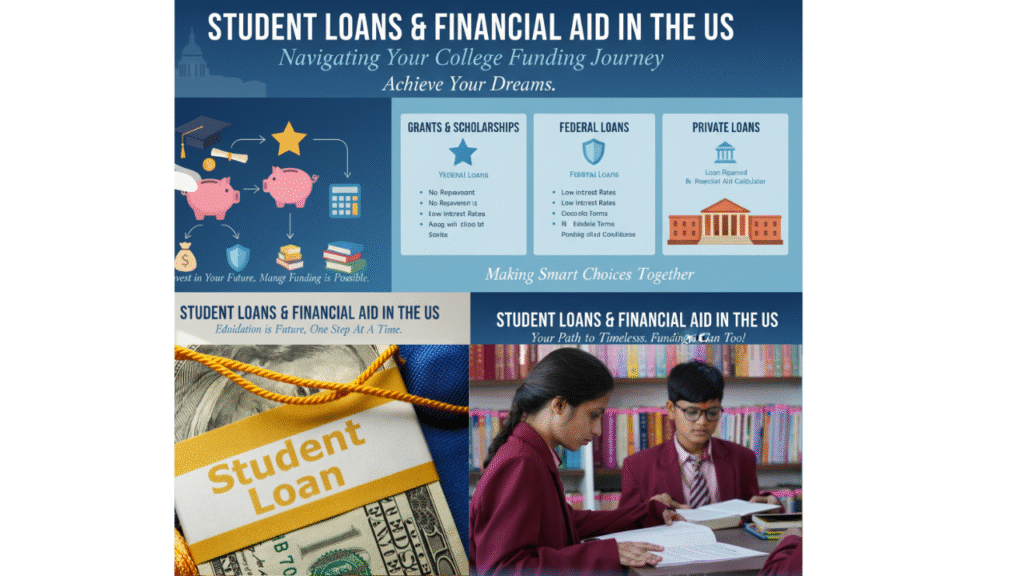
A student loan is money borrowed to pay for college, which must be repaid with interest. Unlike scholarships or grants, loans are not free money. They come in two main forms:
- Federal Student Loans – These are funded by the US Department of Education. They usually have lower interest rates and more flexible repayment options. Examples include Direct Subsidized Loans, Direct Unsubsidized Loans, and PLUS Loans.
- Private Student Loans – These are offered by banks, credit unions, or private lenders. Interest rates are usually higher, and repayment flexibility is limited. Students often turn to private loans when federal loans aren’t enough.
While loans provide immediate financial relief, they can quickly add up and create long-term stress. That is why understanding financial aid options is so important.
The Student Loan Situation in the US (2025 Update)
The US student loan problem has reached historic levels. Here are some updated facts:
- Total student loan debt in the US has surpassed $1.7 trillion.
- About 45 million Americans are currently paying off student loans.
- The average debt per student borrower is nearly $37,000.
- Federal loan forgiveness programs remain a heated political issue, with debates around who qualifies and how much debt can be forgiven.
With tuition fees rising every year, students are forced to rely on loans more than ever. This is why financial aid plays such a critical role—it can significantly reduce how much you need to borrow.
What is Financial Aid?
Unlike loans, financial aid helps students pay for college without creating debt. It can come in many forms:
- Scholarships – Awarded based on merit, academics, sports, or special achievements.
- Grants – Usually need-based aid from the government or schools, which does not need to be repaid.
- Work-Study Programs – Part-time jobs provided by colleges, allowing students to earn money while studying.
- Employer Sponsorships – Some companies pay for employees’ higher education.
The key difference is simple: Loans = repay with interest. Financial aid = free or earned support.
Types of Financial Aid in the US
1. Federal Student Aid (FAFSA)
The most important step for students in the US is filling out the FAFSA (Free Application for Federal Student Aid). FAFSA determines eligibility for federal grants, scholarships, work-study, and loans. Almost every college uses FAFSA to decide how much aid a student gets.
2. State-Level Programs
Many US states run their own aid programs. For example:
- Cal Grants in California
- TAP (Tuition Assistance Program) in New York
- HOPE Scholarship in Georgia
3. Institutional Scholarships
Colleges and universities often provide their own scholarships, especially for high-achieving students, athletes, or those with special talents.
4. Private Scholarships
Thousands of NGOs, foundations, and companies offer scholarships to US students. Websites like Fastweb and Scholarships.com help students find opportunities.
5. Employer Programs
Some employers in the US, such as Starbucks or Amazon, provide education benefits where they sponsor tuition costs for employees.
How to Apply for Financial Aid in 2025
The process is straightforward but needs attention to detail:
- Fill FAFSA Early – Applications usually open on October 1 each year. Apply as early as possible for maximum aid.
- Check Deadlines – Each state and college may have different deadlines.
- Prepare Documents – Income details, tax returns, and personal identification are needed.
- Search Private Scholarships – Don’t rely only on FAFSA. Apply to multiple scholarship programs.
- Keep Your Grades Strong – Many aid programs require a minimum GPA to qualify.
Loans vs Financial Aid: Pros & Cons
| Aspect | Student Loans | Financial Aid |
|---|---|---|
| Repayment | Must be repaid with interest | No repayment needed |
| Availability | Widely available | Limited, competitive |
| Financial Pressure | Creates long-term debt | Relieves burden |
| Accessibility | Anyone can apply | Often needs merit or need-based proof |
How to Reduce Student Loan Burden
Even if loans are unavoidable, students can take steps to make repayment easier:
- Borrow Only What You Need – Don’t take the full amount offered if you don’t need it.
- Consider Community Colleges First – Completing the first two years at a community college can save thousands of dollars.
- Look into Loan Forgiveness Programs – Programs like Public Service Loan Forgiveness (PSLF) can erase debt after working in qualifying jobs.
- Refinance Loans – Some lenders offer lower interest rates if you refinance.
- Work Part-Time or Freelance – Many US students balance studies with online jobs, tutoring, or internships.
- Budget Smartly – Cutting down on non-essential expenses reduces the need to borrow more.
Real-Life Insights from Students
- Maria, 24 (New York): She managed to cut her student loan in half by applying for multiple private scholarships. “I spent hours applying, but it was worth every second.”
- James, 27 (California): He joined a loan forgiveness program after becoming a public school teacher. “Ten years of payments is tough, but knowing the rest will be forgiven keeps me motivated.”
- Ashley, 21 (Texas): She chose community college first and then transferred to a four-year university. “It saved me nearly $20,000 in tuition.”
The Future of Student Loans & Financial Aid in the US
As of 2025, experts predict a shift toward blended financing. Students will use a mix of small federal loans, scholarships, and employer sponsorships rather than relying on loans alone. With the rise of online education and skill-based programs, more affordable alternatives are also available.
Some policymakers are pushing for wider loan forgiveness, while others focus on expanding financial aid. Either way, the message is clear: the old model of relying heavily on loans is unsustainable.
Online vs Traditional Education in 2025: Best Choice?
Top 10 Study Hacks for US College Students in 2025